

2026-01-20T09:06:19
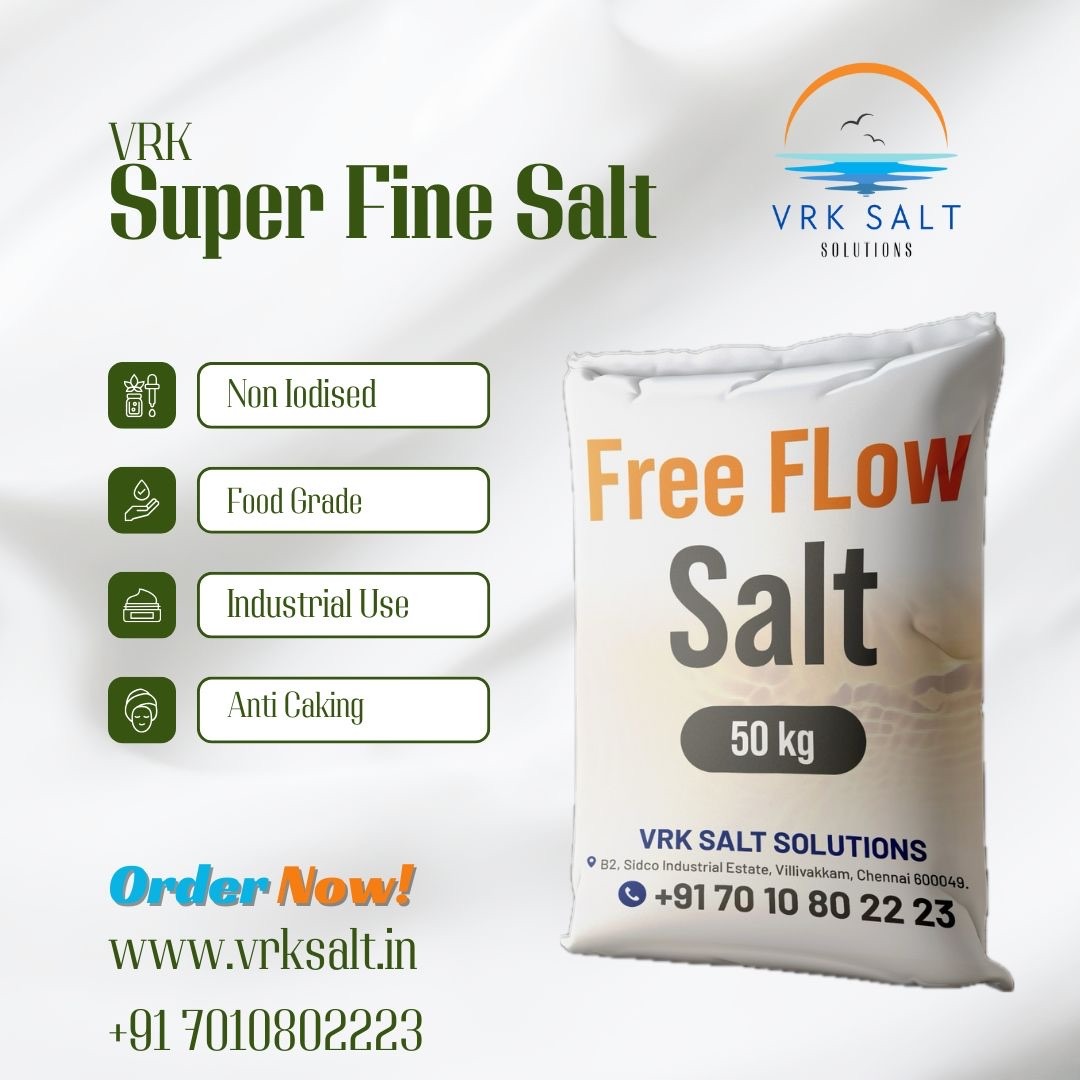
Salt is a foundational raw material for both the food industry and the chemical industry. While it is often treated as a commodity, the **grade, particle size, purity, and flow characteristics of salt** have a direct impact on product quality, process efficiency, and operational consistency. In this context, **superfine salt** has emerged as a preferred choice over conventional coarse or standard refined salt. This article explains, in a structured and industry-focused manner, why superfine salt is technically and commercially superior for food and chemical applications. --- 1. Superior Quality and High Purity Superfine salt is manufactured through advanced refining and controlled milling processes that remove unwanted impurities such as insoluble matter, excess moisture, and foreign particles. The result is a **high-purity sodium chloride product with consistent chemical composition**. Industry relevance: * **Food industry:** Ensures compliance with food safety standards and prevents off-flavours or contamination. * **Chemical industry:** Provides predictable reaction behaviour and minimizes interference from impurities in downstream processes. High purity directly translates into **process reliability and repeatable outcomes**, which are critical in both sectors. --- 2. Enhanced Solubility and Faster Dissolution One of the most important technical advantages of superfine salt is its **small and uniform particle size**, which significantly increases surface area. This allows the salt to dissolve **faster and more uniformly** compared to regular salt. Benefits: * Rapid dissolution in water, brine, syrups, and liquid formulations * Uniform salt concentration without sedimentation * Reduced mixing time and energy consumption Applications: * Food processing (soups, sauces, bakery mixes, seasoning blends) * Chemical solutions, brine preparation, and liquid-based reactions Improved solubility enhances **process efficiency and product consistency**. --- 3. Better Control Over Flavor and Texture (Food Industry) In food manufacturing, precise salt distribution is essential to achieve consistent taste, mouthfeel, and texture. Superfine salt disperses evenly throughout the product matrix due to its uniform particle size. Key advantages: * Even flavour distribution across batches * Improved sensory consistency * Lower risk of salt hotspots or uneven seasoning This is particularly important in: * Bakery products * Ready-to-eat foods * Snack seasonings * Powdered food mixes Superfine salt enables **accurate formulation and repeatable quality**, especially in automated production lines. --- 4. Reduced Clumping and Improved Flowability Traditional salts are prone to **caking and clumping**, especially in humid environments or during long storage periods. Superfine salt, when properly processed and treated with suitable anti-caking measures, offers **excellent free-flow characteristics**. Operational advantages: * Smooth flow through hoppers, feeders, and conveyors * Reduced blockages in automated dosing systems * Improved handling during packaging and transportation For the chemical industry, where uninterrupted material flow is essential, this property directly improves **plant efficiency and uptime**. --- 5. Compatibility with Automated and High-Speed Processes Modern food and chemical plants rely heavily on automation. Superfine salt is particularly well-suited for: * Automated weighing systems * Continuous blending and dosing equipment * High-speed packaging lines Its consistent particle size and flow behaviour reduce calibration errors and minimize material wastage. This makes superfine salt ideal for **large-scale, high-throughput industrial operations**. --- 6. Versatility Across Multiple Applications Superfine salt is not limited to a single use case. Its properties make it suitable for a wide range of applications, including: * Food processing and seasoning blends * Pharmaceutical and nutraceutical formulations * Chemical manufacturing and brine systems * Industrial processes requiring precise salt input This versatility allows manufacturers to standardize on a single high-quality salt grade, simplifying procurement and quality control. Conclusion Superfine salt offers clear technical and operational advantages over conventional salt for both the food industry and the chemical industry. Its **high purity, rapid solubility, consistent particle size, reduced caking, and excellent flowability** make it a reliable and efficient raw material for applications that demand precision and consistency. For manufacturers focused on quality, efficiency, and process control, superfine salt is not merely an alternative—it is a **strategic improvement** over traditional salt grades. Superfine salt, food industry salt, chemical industry salt, high purity salt, enhanced solubility salt, free flow salt, industrial salt, anti-caking salt, food grade salt, non-iodised salt Superfine salt for food industry, superfine salt for chemical industry, free flow industrial salt, high purity non iodised salt, salt with better solubility, anti caking salt for factories, industrial food grade salt
Have a question? Ask here!
Required fields are marked *